Irish republican cause
Say NothingThe Irish republican cause is both a claim about Ireland’s political future and an inheritance carried through family stories, public rituals, and armed action. In the Price family, it meant that British rule was understood as occupation and that Irish people had a duty to end it; over the course of the conflict, the same commitment could lead from peaceful protest to paramilitary membership, electoral politics, or furious opposition to compromise. Its history in the book is therefore not a simple progression toward peace. The cause persists through changing strategies, while arguments about the meaning and cost of those changes remain unsettled.
Inherited history and the meaning of the cause
On Slievegallion Drive in Andersonstown, political history was part of domestic life. Albert Price told his children about joining the Irish Republican Army as a boy in the 1930s and going to England as a teenager for a bombing raid. The family displayed prison photographs where other households might have placed holiday pictures. Stories of imprisoned or hanged comrades, and of Albert’s escape from a jail in Derry with twenty other prisoners, made the struggle feel not like a distant past but like the natural setting of family memory. Even practical knowledge, such as how to handle materials for making explosives, passed into the household’s everyday conversation.
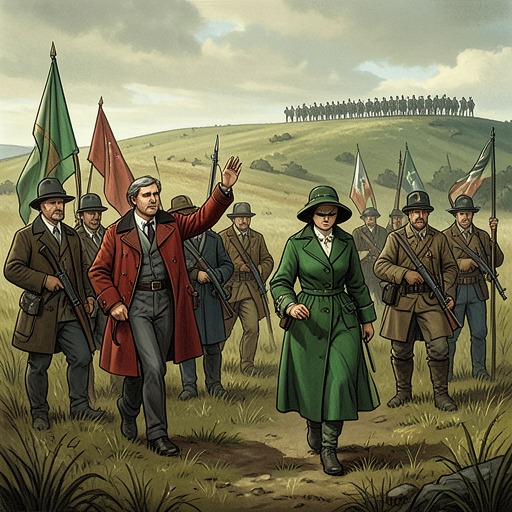
That inheritance reached back through several versions of Irish history. The book traces the family’s understanding of the cause through the Norman incursions, Tudor rule, and the plantation of the seventeenth century, but gives particular weight to the 1916 Easter Rising. The revolutionaries’ proclamation of an independent republic and the execution of Patrick Pearse and fourteen of his comrades became a central republican story: a rebellion defeated in the moment, yet remembered as a declaration of national right and a model of sacrifice. After the Irish War of Independence and the Partition of Ireland in 1921, the South achieved a measure of independence while six northern counties remained under British rule. For staunch republicans such as the Prices, even the name used for the North registered political allegiance; language itself could mark whether that division was accepted.
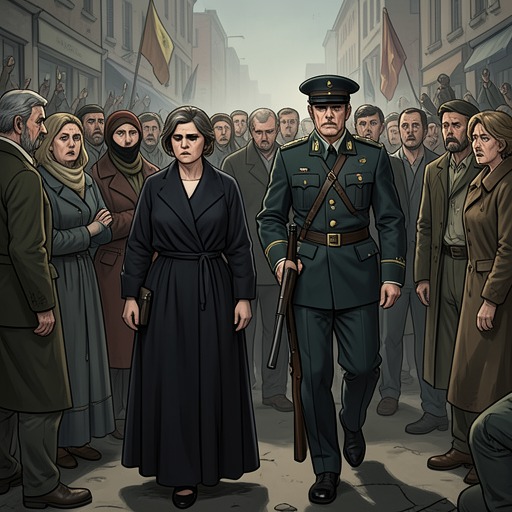
Commemoration made this inherited history visible and, at times, dangerous. Under the Flags and Emblems Act, displaying the Republic of Ireland’s tricolour in the North could bring imprisonment. As a child, Dolours Price wore an Easter lily on Easter Sunday and covered it with her hand when she saw a police officer approaching. The gesture combined ritual, risk, and belonging: the past was not only recited but enacted in public, under the possibility of punishment. The book also places the ideal of sacrifice beside its bodily consequences. Aunt Bridie was permanently blinded and disfigured when explosives detonated as she helped move them in 1938. The cause offered a language of honour and continuity, but its costs were already present in the family’s intimate life.
Discrimination, protest, and the turn to arms
The Belfast–Derry civil-rights march of January 1969 arose from unequal conditions in Northern Ireland. Catholics faced exclusion from desirable employment and housing and lacked executive political power; no Catholic had held executive office at Stormont during the system’s first half-century. Emigration helped keep the Catholic population virtually static despite a higher birth rate. The marchers’ demand for civil rights sought to challenge discrimination through public, peaceful action, and some hoped that the political conflict could be reframed as a struggle between young people and entrenched authority rather than as an unchangeable contest between Catholics and Protestants.
That hope was shaken by violence on the route. The procession encountered Protestant villages where armed men blocked access, and protesters were forced to detour. At Burntollet Bridge, the experience became a turning point for Dolours and Marian Price. Dolours had considered peaceful resistance capable of changing Northern Ireland; afterward she concluded that marching alone would not produce the change she believed Ireland needed. Her father later said that both sisters had returned from the experience altered. The shift was not presented as an abstract rejection of nonviolence but as a response to what they had encountered and to their judgment that the existing means of protest had failed.
The political and organizational conditions also changed. During the 1969 riots, barricades formalized neighbourhood boundaries that would later be reinforced by peace walls. Local residents helped warn republican activists of raids by striking dustbin lids against the pavement, while children whistled to signal danger. At the same time, the Irish Republican Army was weak, short of weapons, and divided over whether armed struggle or political resistance offered a future. Some leaders had turned toward Marxist politics; only about a hundred members remained in Belfast, and weapons had even been sold to the Free Wales Army in 1968. These circumstances shaped the revival of armed organization as well as the community solidarity that surrounded it.
In 1971, Dolours joined the Irish Republican Army, taking an oath of allegiance in the front room of her family home. She understood this decision as a return to the convictions in which she had grown up. When Seán Mac Stíofáin initially proposed that she join Cumann na mBan, the women’s auxiliary, she insisted that she wanted the same work as a man: to fight as a soldier, not to provide support. A special meeting of the Provisionals’ Army Council then determined that women could join as full members for the first time. Her admission marked a change in the organization’s rules; it also exposed the practical pressures behind that change, since mass arrests had removed men from the ranks. Yet formal equality did not guarantee equal treatment. Soon after swearing in, Price was ordered to clean a heap of dirty, mismatched bullets with steel wool. She obeyed, understanding the menial assignment as both a test and an initiation into a movement whose discipline she had promised to accept.
Armed struggle, elections, and negotiation
The cause’s methods changed again as armed action encountered political opportunity. During the 1981 hunger strike, the death of Frank Maguire created a by-election in Fermanagh and South Tyrone. Republicans decided that Bobby Sands should stand while imprisoned, turning an election into a means of drawing attention to the strikers and challenging the government’s treatment of them. The proposal broke with a longstanding suspicion of parliamentary politics. Sands’s candidacy and victory demonstrated that elections could serve the movement even while a prisoner’s protest remained at its center.
Dolours Price later worked within this emerging electoral strategy. After abandoning violence as her own means of pursuing Irish unity, she canvassed for Sinn Féin and supported Gerry Adams when he stood for West Belfast in 1983. Adams promised that, if elected, he would boycott Westminster, preserving an older republican refusal to recognize the parliament even as he sought a parliamentary mandate. Price campaigned for him and drove voters to polling stations. Her participation shows that rejection of armed action did not mean abandoning republican identity; electoral work could be adopted as another means of pursuing the cause.
Adams’s political development reflected that strategic transformation. He became convinced that a united Ireland could not be won by force alone, although he could not simply announce that conclusion to the IRA’s rank and file without risking opposition. As Sinn Féin’s president and a public representative, he maintained a distinction between his political role and direct IRA membership, while defending republican arguments about the origins and moral accounting of violence. He insisted that the IRA should not be judged apart from the British state and argued that voting papers alone would not end British rule. This position joined political participation to an account of armed struggle rather than treating the two as mutually exclusive.
The IRA ceasefire announced in August 1994 brought that tension into the open. At a West Belfast social club, representatives presented the decision as neither victory nor defeat. Dolours Price asked whether the movement was being told, in retrospect, that it should never have undertaken armed struggle. Her question exposed the difference between a leadership’s strategic turn and the understanding of those who had fought under its orders. The ceasefire offered Sinn Féin wider acceptance and a route into conventional politics, but it did not deliver the national outcome for which many volunteers believed they had sacrificed. Reassurances that the ceasefire could be reversed did not remove the unease surrounding compromise.
The settlement and its disputed legacy
For Brendan Hughes, the Good Friday Agreement formalized the republican movement’s acceptance that British rule would continue. He had killed in the belief that he was fighting for a united Ireland; he came to believe that the leadership had been prepared to settle for less while withholding that intention from volunteers. His anger focused on Gerry Adams, once his closest comrade. A photograph of the two men together in Long Kesh remained on Hughes’s wall, a record of intimacy that now sharpened the sense of betrayal. The language of decommissioning, applied to weapons, became for Hughes a bitter way to describe his own feeling of having been used and discarded.
Dolours Price experienced the settlement as a personal repudiation of the world into which she had been born and of the actions she had taken in its name. Her friend Eamonn McCann observed that the agreement affected her more intensely than it did many others. She had set bombs, robbed banks, lost friends, and nearly died, believing those acts served national liberation. Once the political result seemed to invalidate that justification, she felt not only political disappointment but moral injury: the conviction that she had been left without an ethical account of her own conduct. This helps explain why she could reject a return to war while remaining unable to accept the movement’s preferred account of peace.
Her objections also concerned who had the authority to tell the history. At a republican commemoration in County Mayo in 2001, Price objected to people saying they had never been in the IRA and identified Adams as her commanding officer. Sinn Féin’s efforts to discredit or silence critics intensified her anger. She attended some meetings of armed splinter groups but did not join them, asking what a return to war would accomplish. Her opposition to the settlement therefore did not amount to support for renewed violence; it expressed a demand that the past, including her own part in it, not be denied or smoothed into a politically convenient story.
The book’s account of the postwar years returns to the idea that wars are fought again in memory. Gerry Adams’s continuing refusal to acknowledge IRA membership suggested that disclosure remained risky, while Sinn Féin’s control over its public account of the struggle constrained dissenting interpretations. The party was described as maintaining a monopoly over the memory of republican armed struggle. Yet the persistence of republican and loyalist organizations could also help contain violence: a report discussed in the book argued that their hierarchies retained enough authority to restrain members and manage dissent. Political discipline thus appears in two lights—as a means of sustaining a unified public narrative and as a mechanism that may prevent renewed conflict.
The cause’s afterlife is visible in Belfast itself. The city center acquired familiar shops, a film industry, and tours that presented former flashpoints as history, while more than 90 per cent of children in Northern Ireland still attended segregated primary schools and neighbourhood boundaries remained marked by flags and peace walls. A tourist’s view of the Troubles as distant history coexisted with residents’ daily navigation of division. The cause had moved from armed struggle toward electoral politics and a negotiated settlement, but neither the settlement nor the passage of time settled what the struggle meant, what it had achieved, or who could speak for it.